
If you have a large live-edge slab sitting in your workshop, you have probably run into the same problem: it is too wide for a standard planer, but you still need a flat surface before sanding and finishing.
That is where a router sled comes in.
You can build one yourself from lumber and hardware, or you can buy a ready-made commercial router sled. Both approaches work. The better choice depends on the size of your slabs, how often you flatten wood, and whether you would rather build the tool or start using it.
For larger woodworking projects, a commercial system such as a 57.1-inch router sled can save a considerable amount of setup work while giving you a dedicated guide system for slab flattening.
A router sled is a rail-guided setup that lets a router move across the surface of a large workpiece.
Instead of trying to move a heavy slab through a planer, you secure the slab and move the router over it. The router removes material from the high spots until the surface becomes flat enough for the next stage of the project.
A router sled works particularly well for:
The basic idea is simple: two rails support a router carriage, and the carriage moves across the workpiece in controlled passes.
A DIY router sled can be as simple or as elaborate as you want.
Most homemade versions use straight boards, plywood, aluminum rails, or a combination of shop-made parts. You need two parallel rails and a carriage that holds the router securely while allowing it to travel from one side of the workpiece to the other.
The attraction is obvious. You can build the sled around your own workspace and make it as long as your largest slab.
If you regularly flatten 40-inch slabs, for example, there is little reason to build a system designed around a much larger work area.
The biggest advantage is flexibility.
You control the dimensions, materials, and layout. If you already have straight lumber and some workshop hardware, the cost can also be relatively low.
A DIY sled makes particular sense if you:
There is also something satisfying about using a tool you built yourself.
The downside is that you are responsible for everything.
The rails need to be straight and properly aligned. The carriage needs to move smoothly. The router needs a secure mounting position. The entire system needs enough stability to maintain a consistent cutting path.
A small alignment problem can show up as an uneven surface on the finished slab.
And building the sled takes time.
If you only need to flatten a slab occasionally, that may not matter. If you have several slabs waiting in the shop, the time spent building and adjusting the sled starts to become part of the cost.
A commercial router sled gives you a ready-made rail and carriage system instead of requiring you to fabricate one from scratch.
The exact design varies between products, but the goal is the same: provide a stable path for the router across the workpiece.
The main advantage is convenience.
You do not have to spend time figuring out how to build the rails, how to make the carriage, or how to make the components work together. You still need to assemble and level the system, but most of the basic design work has already been done.
The biggest difference is not necessarily the final result.
Both types can flatten a slab effectively when they are properly set up.
The real difference is time, convenience, and customization.
| Feature | DIY Router Sled | Commercial Router Sled |
|---|---|---|
| Initial Cost | Usually lower | Usually higher |
| Build Time | Higher | Lower |
| Custom Dimensions | Excellent | Depends on model |
| Setup Convenience | More work | Easier |
| Rail Length | You choose | Depends on product |
| Modification | Easy | More limited |
| Best For | DIY-focused woodworkers | Frequent slab flattening |
A DIY sled is a good choice when the build itself is part of the fun.
It also makes sense if you need unusual dimensions.
Maybe your workshop handles slabs that are 70 inches wide. Or perhaps you want a very specific rail arrangement that is not available commercially.
Building your own system lets you design around those requirements.
There is one thing I would not compromise on, though: rail alignment.
Straight rails and a stable carriage matter much more than whether the sled looks professional.
A commercial router sled makes more sense when you would rather spend your time flattening wood than building the equipment used to flatten it.
This becomes especially noticeable when working with large slabs.
A ready-made system can give you:
For a woodworker who only flattens one slab every year, the convenience may not justify the purchase.
For someone working on several tabletops, live-edge slabs, or workbenches every month, it can be a different story.
Rail length is one of the first specifications to check when choosing a router sled.
A sled needs enough guide length to cover the workpiece while still giving the router carriage room to move.
For example, a 57.1-inch router sled provides a longer working span than many compact shop-built setups. That makes it useful for larger woodworking projects such as:
The important thing is to compare the rail dimensions with the actual size of your workpieces.
A longer rail does not automatically make a sled better. It simply gives you more room to work.
If this is your first time flattening a slab, a commercial router sled can be the less frustrating option.
You still need to understand the basics. The slab must stay secure, the rails must sit correctly, and the router needs to move smoothly.
But you do not also have to solve the engineering problem of designing the sled itself.
A DIY setup can be a great second step once you know what you want from a router sled.
After using one for a few projects, you will have a much better idea of which dimensions, rail style, and carriage design suit your workshop.
For large slabs, sometimes it can fill a gap that a planer simply cannot.
A standard planer has a fixed opening width. A wide live-edge slab may not fit through it at all.
A router sled works from above, so the size of the slab is limited mainly by the working range of your guide system and the available workshop space.
That makes a router sled particularly useful for large pieces that would otherwise require specialized machinery.
It is not necessarily faster than a planer for ordinary boards, though.
If you are preparing standard-width lumber, a planer is usually much more practical. A router sled really shines when the workpiece gets too large, irregular, or awkward for conventional equipment.
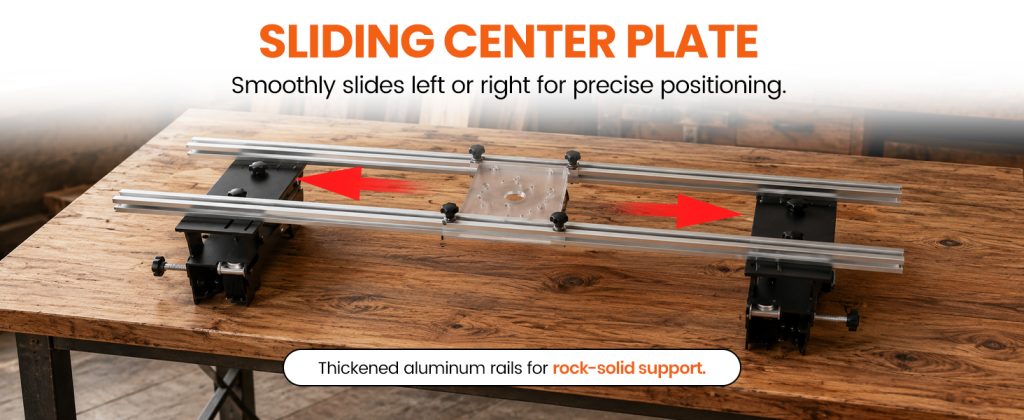
For woodworkers who want a ready-made option, the EONECROSS Router Sled for Flattening Slabs uses a 57.1-inch horizontal guide rail to provide broad coverage for large woodworking projects.
The rail-guided carriage gives the router a controlled path across the slab, helping you make consistent passes while flattening rough or uneven surfaces.
It is suited to projects such as:
The system is designed as a practical alternative to building a complete router sled from scratch.
Assembly is required, and the router itself is not included.
Before choosing a commercial sled, look beyond the product title.
Make sure the rail system can cover your largest planned workpiece.
The router needs to mount securely to the carriage. Check the product specifications before purchasing.
The carriage should move smoothly along the rails without excessive play.
A 57-inch rail system is useful for large projects, but it also takes up more storage space than a compact sled.
If slab flattening is an occasional project, building your own sled may be enough.
If you do it regularly, the convenience of a commercial system becomes more valuable.
There is no universal answer.
Choose a DIY router sled if you enjoy building workshop equipment, want complete control over the dimensions, or already have most of the materials.
Choose a commercial router sled if you want to spend less time fabricating equipment and more time working on your slabs.
For larger woodworking projects, a system with a longer guide rail can also save you from constantly working around the limitations of a small sled.
The EONECROSS 57.1-inch router sled is a practical option for woodworkers who want a ready-made guide system for large slabs without building the entire sled themselves.
In the end, the best router sled is the one that fits the work you actually do. Measure your largest slabs, look at the available working space, and decide how much of the sled-building process you really want to take on yourself.