
When contractors think about upgrading a cargo van, the first things that usually come to mind are roof racks, shelving, and tool storage.
Very few people start by looking at the wheel wells.
Ironically, that’s one of the most underused spaces inside almost every work van.
Whether you drive a Ford Transit, Mercedes-Benz Sprinter, Ram ProMaster, or Chevrolet Express, the wheel wells naturally create awkward gaps that many shelving systems simply ignore.
Over time those empty areas become dumping grounds for extension cords, straps, gloves, fittings, and loose tools.
The result isn’t just a messy van.
It slows down your workflow.
Instead of thinking about adding more shelving, many experienced contractors are now thinking differently:If you’re comparing different storage options, browse our Cargo Van Shelving Collection to see modular shelving systems designed for commercial work vans.
How can every inch of existing space work smarter?
That question is exactly where wheel well shelving becomes valuable.
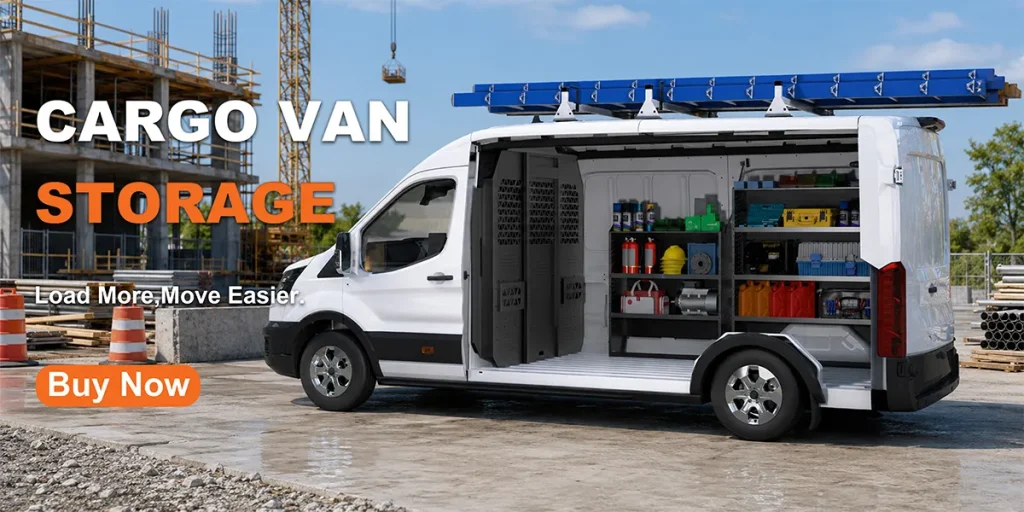
Most commercial shelving systems are designed to maximize vertical storage.
That sounds great on paper.
In reality, every contractor works differently.Different vehicle sizes require different layouts. Here are several Ford Transit Shelving Ideas that maximize storage without sacrificing floor space.
Electricians carry conduit.
HVAC technicians carry refrigerant tanks.
Plumbers need space for pipe, fittings, and longer materials.
General contractors may load plywood one day and palletized supplies the next.
A shelving system that fills an entire wall often creates another problem:
there isn’t enough open floor space left.
Many contractors eventually discover that they don’t actually need more shelves.
They need better placement.
This is where wheel well storage begins to make sense.
Instead of installing another full-height cabinet, that otherwise unused space around the wheel well can become dedicated storage for smaller tools and frequently used supplies.
One of the most common themes discussed among contractors is surprisingly simple:
Don’t sacrifice floor space just to gain another shelf.
The center aisle is often the most valuable part of the van.
It allows you to:
Once that aisle becomes crowded with oversized shelving, every job becomes slightly slower.
That’s why more fleet managers and experienced tradespeople are moving toward layouts that keep storage against the walls while preserving an open working corridor.Many professional installers also combine interior storage with Van Roof Racks Collection to keep bulky materials outside the cargo area.
Instead of forcing every square inch into storage, they’re protecting the space that improves productivity.
Most wheel wells are already occupying space that cannot be removed.
The question becomes:
How can that unavoidable obstruction become useful?
Rather than building around it with bulky wooden cabinets, contractors often choose smaller storage zones designed specifically for that area.For contractors looking for complete systems instead of DIY builds, explore our Best Cargo Van Shelving for Contractors guide.
Typical uses include:
These items don’t require full-height shelving.
They simply need a consistent home.
That simple change alone can free multiple shelves for larger equipment.
A recent discussion among work van owners highlighted something interesting.
One contractor explained that he regularly transports palletized cargo.
Instead of installing shelving across both walls, his priority was keeping approximately fifty inches of clear floor space down the center of the van.
His goal wasn’t maximizing storage.
It was maintaining loading efficiency.
He planned to build lightweight storage only between the wheel wells and the side walls, leaving the middle completely open.
Several experienced van owners agreed with the concept.
Rather than packing every wall with cabinets, they preferred modular storage that adapts to different jobs throughout the week.
That reflects a broader trend.
Today’s contractors are optimizing workflow—not simply adding more storage.
DIY shelving has always been popular.
A few sheets of plywood, basic hardware, and a weekend in the garage can create a functional storage system.
But permanent wooden shelving has limitations.
It adds weight.
It reduces payload.
It’s difficult to modify later.
And if your work changes, the shelving often has to be rebuilt from scratch.
Modular steel shelving offers a different approach.
Instead of committing to one fixed layout, individual sections can be adjusted, expanded, or removed as your business grows.
For contractors who perform different types of work each week, that flexibility can be more valuable than maximum storage capacity.
There isn’t a single shelving layout that works for every contractor.
The best design depends on how your van is used every day.
For example, an electrician typically needs quick access to hand tools, cable reels, connectors, and testing equipment. That often means open shelving near the side door and smaller storage compartments close to the wheel wells.
An HVAC technician usually carries larger equipment, refrigerant cylinders, recovery machines, and replacement parts. In this case, keeping the center aisle open becomes even more important because heavy equipment needs to move in and out efficiently.
Plumbers face a different challenge. Long sections of pipe, fittings, sealants, and power tools all compete for the same storage space. A combination of wall-mounted shelving and low-profile wheel well storage often provides the best balance.
The goal isn’t to fit the most equipment into the van.
The goal is to reduce the number of unnecessary steps between arriving at the job site and getting to work.
Many contractors spend thousands of dollars upgrading their vans.
Ironically, some of the biggest productivity improvements come from much smaller changes.
Examples include:
These improvements don’t require rebuilding the entire van.
They simply make better use of the available space.
When every tool has a designated location, loading becomes faster, unloading becomes easier, and missing tools become much less common.
One mistake many van owners make is designing their storage around today’s workload instead of next year’s.
Businesses evolve.
New tools are purchased.
Services expand.
Employees change.
A shelving system that cannot adapt eventually becomes another obstacle.
Before installing any storage solution, ask yourself a few questions:
Thinking ahead now can save significant time and money later.
One trend has become increasingly clear across work van communities.
People are moving away from permanent, oversized storage systems.
Instead, they want layouts that can change as their work changes.
A modular approach offers several practical advantages:
Rather than treating a cargo van as a fixed workshop, contractors are treating it as a workspace that evolves over time.
That shift explains why adjustable shelving systems continue to grow in popularity.
Wheel well storage isn’t about adding more shelves.
It’s about making better use of space that already exists.
For contractors who regularly transport tools, materials, or palletized cargo, preserving an open center aisle while organizing the side areas often creates a much more efficient workflow.
Every business operates differently.
Some prioritize storage capacity.
Others prioritize flexibility.
The most effective cargo van layouts usually achieve both by combining modular shelving, thoughtful organization, and smarter use of overlooked areas like the wheel wells.
Before adding another cabinet, take another look at the space around your wheel wells.
You may discover that the best storage solution has been there all along.
A: Yes. Many contractors use wheel well areas for storing smaller tools, hardware, fasteners, electrical supplies, gloves, safety gear, and frequently used consumables. Low-profile storage keeps these items organized without reducing usable floor space.
A: Not necessarily. They serve different purposes. Full-height shelving provides maximum storage capacity, while wheel well shelving helps organize otherwise unused space and supports more flexible van layouts.
A: For palletized cargo, keeping the center aisle open is usually the most efficient approach. Side-mounted shelving and wheel well storage allow contractors to maintain access while preserving valuable loading space.
A: Modular shelving is typically lighter, easier to adjust, and simpler to expand as business needs change. DIY shelving can be effective but may add significant weight and is often harder to modify later.
A: Almost every full-size cargo van can benefit, including:
A: Yes. It works well for organizing connectors, testers, hand tools, wire accessories, and frequently used electrical components.
A: Absolutely. Small replacement parts, fittings, gauges, hoses, and safety equipment can all be stored efficiently while leaving larger equipment in the main cargo area.
A: Very heavy equipment, oversized machinery, or items that require frequent lifting are generally better stored on stronger shelving or directly on the cargo floor.
Instead of forcing your van into a one-size-fits-all shelving layout, consider how your daily workflow actually operates.
Explore the Cargo Van Shelving Collection to compare modular storage solutions, or browse our Ford Transit Shelving Ideas and Van Roof Racks Collection for additional organization strategies designed for professional work vans.