
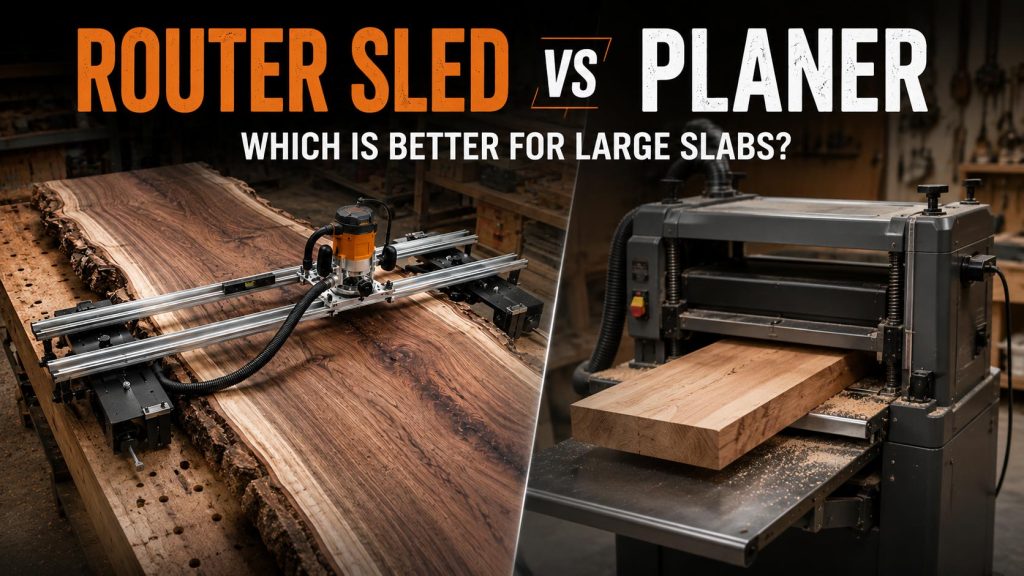
If you work with live-edge slabs, you have probably run into the same problem: the piece is wider, heavier, or more irregular than the planer you have in the shop.
That is where the choice between a router sled vs planer becomes important.
For standard boards, a planer is usually faster and more convenient. For wide live-edge slabs that will not fit through a planer, a router sled often makes more sense. Neither tool is automatically better. The right choice depends on the size of the wood, how much material you need to remove, and how often you work with large slabs.
Here is how the two methods compare in real woodworking situations.
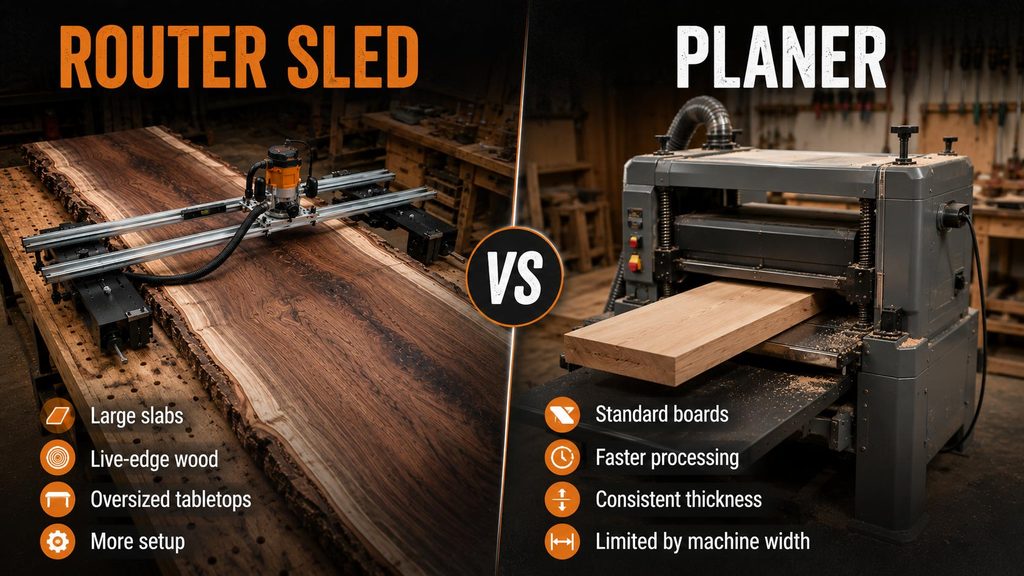
The biggest difference is how the two tools move the wood.
A planer pulls the board through the machine and cuts the top surface as the board passes underneath the cutter head.
A router sled does the opposite. The slab stays in place while the router moves across the top on guide rails.
That difference matters when the workpiece gets large.
A normal planer works very well with boards that fit within its maximum width and height. But a large live-edge slab can quickly exceed those limits.
With a router sled, the main limitation becomes the size of the sled and the space available around the workpiece.
For ordinary boards and smaller woodworking projects, a planer is hard to beat.
It is fast, repeatable, and requires relatively little setup once the machine is ready.
A planer is a good choice when:
For example, if you are preparing a stack of 8-inch-wide boards for a furniture project, a planer will usually be much quicker than setting up a router sled.
You simply feed the boards through, make the required passes, and move on to the next piece.
A router sled becomes more attractive when the workpiece is too wide or irregular for a conventional planer.
Think about a large live-edge slab for a dining table.
The slab may be 30, 40, or even more inches wide. It may also have natural edges and significant variation in thickness.
You cannot simply feed that piece through a typical planer.
A router sled for large slabs allows you to keep the slab on a sturdy support surface while moving the router across it.
That makes the method useful for:
The router sled does take more setup time, but it gives you much more flexibility with large workpieces.
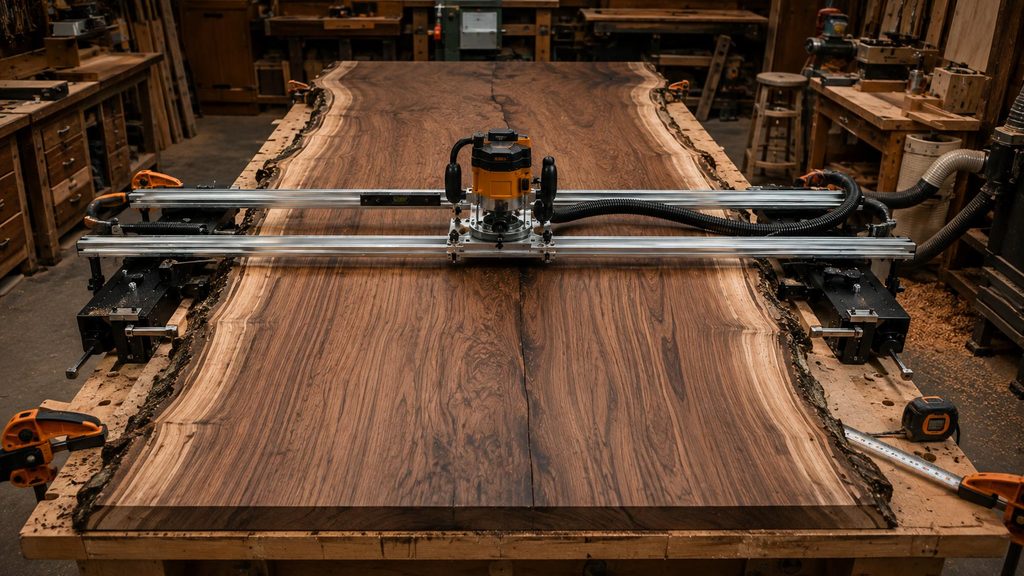
For large slabs, the comparison becomes a little different.
| Feature | Router Sled | Planer |
|---|---|---|
| Large live-edge slabs | Excellent | Usually limited by width |
| Standard boards | Good | Excellent |
| Setup time | More | Less |
| Processing speed | Slower | Faster |
| Oversized workpieces | Very useful | Often unsuitable |
| Thickness control | Good with careful setup | Excellent |
| Irregular slab shapes | Good | Limited |
| Shop space | Requires open working area | Requires machine and feed space |
| Multiple identical boards | Less efficient | More efficient |
| DIY flexibility | High | Low |
So, if you are asking which is better for large slabs, the router sled usually has the advantage.
If you are asking which is better for everyday board thicknessing, the planer usually wins.
Size is probably the first thing to consider.
A planer has a fixed opening. Once your slab exceeds that width, the machine is no longer an option.
A router sled does not have the same feed-opening limitation.
Instead, you choose a sled and rail system that provides enough coverage for your workpiece.
This makes a router sled particularly useful when your projects vary in size.
Before buying either setup, measure the largest slab you expect to work with. Do not just measure the length. Consider the widest section and the amount of travel needed for the router carriage.
This is one area where the planer has a clear advantage.
A planer is generally ready to use once it is set up.
A router sled requires more preparation.
You need to:
For a small board, that may feel like too much work.
For a large slab that cannot go through your planer, however, the extra setup is often worth it.
Both tools can produce a flat surface, but the setup has a major influence on the result.
With a planer, the machine controls the cutter head and feed path for you.
With a router sled, you control the reference plane through the guide rails and supports.
That means you need to pay more attention to the sled setup.
The rails should remain stable and parallel. The slab should also remain firmly supported.
If either moves during flattening, the finished surface can show the problem.
For that reason, a router sled is not simply a matter of putting a router on rails and turning it on. Good preparation matters.
If speed is your main concern, a planer usually wins.
A planer can process a conventional board relatively quickly, especially when you have a number of boards to prepare.
A router sled is slower because you normally remove material in multiple passes.
The router also covers the slab section by section.
However, speed is less important when the alternative is not possible.
If your 36-inch-wide live-edge slab cannot fit into your planer, a slower router sled is still the practical solution.
This is where a router sled really shines.
Live-edge slabs often have irregular edges, changing thickness, knots, voids, and natural curves.
A planer is designed around relatively conventional board shapes.
A router sled works from above, so you can create a controlled reference plane over the irregular workpiece.
You still need to support the slab properly, but the method does not require the entire piece to pass through a machine opening.
For live-edge furniture projects, that flexibility can be more important than raw cutting speed.
Yes.
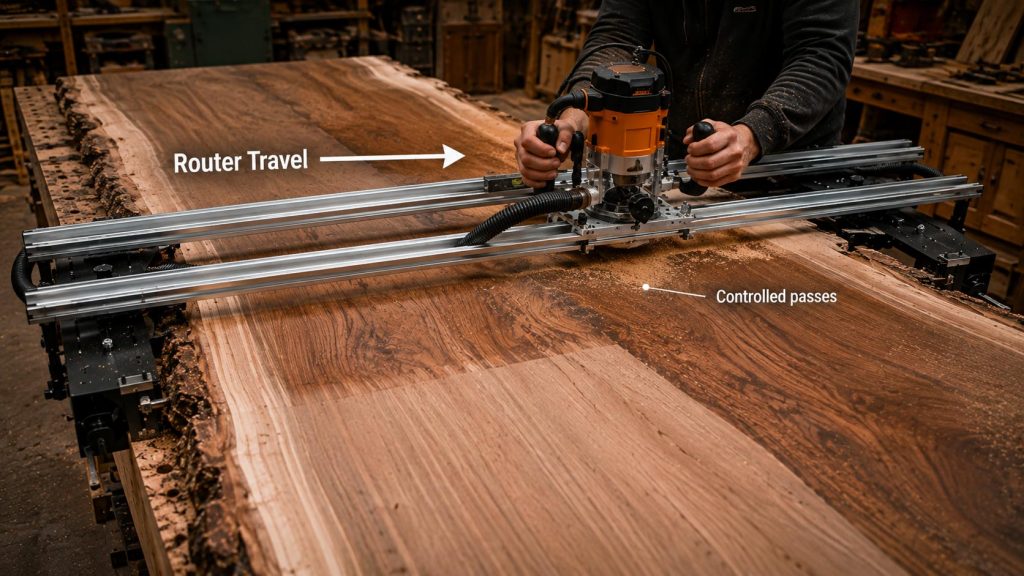
A router sled can flatten a large slab by moving the router across the workpiece in controlled passes. If you’re new to the process, our guide on how to use a router sled for slab flattening walks through the setup, cutting depth, and flattening process step by step.
The basic process is:
Secure the slab → set up the rails → mount the router → make shallow passes → lower the router → repeat.
The first pass usually removes only the highest areas.
You then gradually work down until the surface reaches the desired flatness.
You do not need to remove a large amount of material in one pass.
In fact, trying to do so can make the router harder to control.
There is no single depth that works for every slab.
The amount depends on the condition of the wood, the router, the bit, and how uneven the slab is.
A better approach is to start shallow.
Look at the first pass and see where the cutter contacts the wood. This tells you where the high areas are.
Then make another controlled pass.
If the slab is badly warped, expect to repeat the process several times.
This may take longer, but it gives you more control over the final surface.
The answer depends on what you already own.
If you already have a suitable planer, using it for boards that fit within its capacity is usually the simplest option.
A router sled can be relatively affordable if you already own a compatible router.
You can also build a DIY sled using guide rails and a carriage.
The tradeoff is your time.
Building your own sled takes planning, measuring, fabrication, and testing. A ready-made system costs more upfront but reduces the amount of fabrication involved.
For someone who only works with small boards, neither option may justify the extra investment.
For someone regularly working with large slabs, a dedicated setup can pay for itself in saved time and flexibility.
A DIY router sled can work very well, especially if you enjoy building your own woodworking equipment. If you’re deciding between building one yourself and buying a ready-made system, see our guide to DIY Router Sled vs Commercial Router Sled.
Many woodworkers build their own sleds because the basic concept is straightforward.
A typical setup uses:
The biggest challenge is getting everything straight, stable, and properly aligned.
If the rails flex or move, they can affect the finished surface.
A commercial router sled makes sense when you would rather spend your time flattening wood than building and adjusting the sled itself.
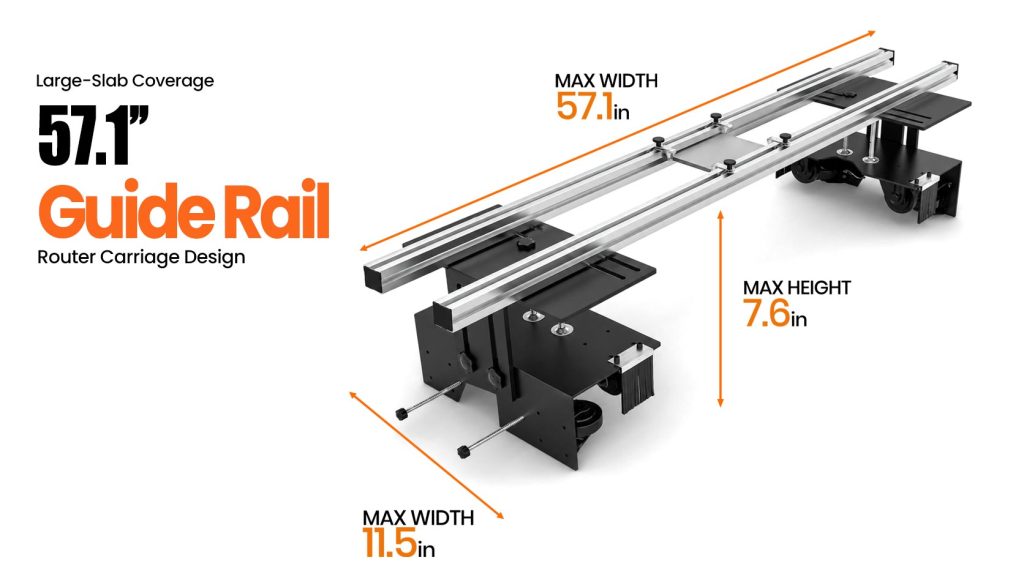
For larger woodworking projects, the length of the guide rail becomes especially important.
The EONECROSS 57.1-Inch Router Sled for Flattening Slabs uses a 57.1-inch-longest horizontal guide rail. That gives the system broad coverage for large slabs, tabletops, workbenches, cutting boards, and similar projects.
The rail-guided carriage provides a controlled path for the router as you work across the surface.
It is designed for both professional workshops and home DIY projects.
The sled requires assembly, and the router is not included.
For a woodworker who already owns a suitable router but does not want to fabricate a complete sled from scratch, this type of setup can be a practical middle ground.
The answer comes down to the work you actually do.
If you regularly work with both standard boards and large slabs, there is no reason you cannot have both.
A planer can handle everyday lumber while a router sled handles the oversized pieces.
Regardless of which method you use, a few basic practices will make the job easier.
Do not allow the slab to rock or shift while cutting.
Removing less material per pass gives you better control.
Before cutting, check the rails, router carriage, supports, and hardware.
Wood chips can interfere with movement and visibility.
The last few passes determine much of the final surface quality.
Inspect the slab from different directions rather than relying only on visual judgment.
A: For oversized slabs, a router sled is usually more practical because the slab does not need to pass through a planer’s feed opening. A planer remains faster for standard-sized boards.
A: Only if the slab fits within the planer’s capacity and has a suitable shape for feeding through the machine. Many large live-edge slabs exceed those practical limits.
A: It depends on the project. For one small slab, building a sled may not be worthwhile. For a wide or expensive slab that cannot fit through a planer, a router sled can be a practical solution.
A: It can create a flat reference surface when the slab, rails, and sled are properly set up. The final surface may still require sanding or additional finishing.
A: Yes. Tabletops are one of the common applications for router sled flattening, especially when the tabletop is wider than the available planer.
A: There is no fixed time. The size and condition of the slab, amount of material to remove, router speed, bit size, and number of passes all affect the total time.
There is no universal winner in the router sled vs planer debate.
For standard boards, a planer is faster and easier.
For large live-edge slabs, oversized tabletops, and irregular workpieces, a router sled gives you something a planer often cannot: the ability to work over the top of a large piece without feeding it through a machine.
So the simple answer is:
Use a planer when the wood fits the machine. Use a router sled when the project is too large or irregular for the planer.
If large slab projects are becoming a regular part of your woodworking, a longer router sled can be a useful addition to your workshop. A 57.1-inch guide rail, like the one used on the EONECROSS Router Sled, provides more room to work with larger surfaces while keeping the basic setup straightforward.